Playable
-
class
narupatools.core.playable.Playable(*, playback_interval: float = 0.1)¶ Object that can be run at a target frame rate with playback controls..
Playables can therefore both represent trajectories (where there are a set number of frames which are played through one by one) and simulations (which generate frames one at a time).
Playables support pausing, restarting and stepping, as well as execution in both background and foreground threads.
Inheritance
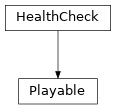
Methods
Create a new playable.
Check if a task has thrown an exception, and reraise it if so.
Check background tasks to ensure they have not encountered an exception.
Pause this object if it is running.
Play the given object.
Restart this back to its initial state.
Run this object, potentially in a background thread.
An alias for run().
Step forward by one step, and then pause the simulation.
Stop the object if it is running.
-
__init__(*, playback_interval: float = 0.1)¶ Create a new playable.
- Parameters
playback_interval – Target interval to run this playable at.
-
classmethod
check_task(task: Optional[concurrent.futures._base.Future]) → None¶ Check if a task has thrown an exception, and reraise it if so.
- Parameters
task – Background task to check for an exception.
-
health_check() → None¶ Check background tasks to ensure they have not encountered an exception.
Calling this allows exceptions raised on background threads to be thrown on the main thread. It is a useful tool for checking if an object has crashed silently in the background.
It is recommended to call this periodically from the main thread to ensure an object is healthy. If no exceptions have occurred, this method will do nothing.
-
pause(wait: bool = True) → None¶ Pause this object if it is running.
This will not cancel the current run if present, merely suspend it until a subsequent call to play() is made.
- Parameters
wait – Wait until the pause has actually occurred.
-
play() → None¶ Play the given object.
If this is not running, run this on a background thread. Else, unpause if this is paused.
-
run(block: Literal[True]) → bool¶ -
run(block: Literal[False]) → concurrent.futures._base.Future[bool] -
run(block: bool) → Union[bool, concurrent.futures._base.Future[bool]] Run this object, potentially in a background thread.
If block is True (as is the default), this object will run in the calling thread. If block is False, it will be run in a background thread.
- Parameters
block – Should this block?
- Raises
PlayableAlreadyRunningError – Playable is running on another thread.
- Returns
If run in blocking mode, returns True if the playable completed and False if it was stopped. If run in non-blocking mode, returns a Future with the same result.
-
stop(wait: bool = True) → None¶ Stop the object if it is running.
If this is running, this object will stop executing at the next available point.
- Parameters
wait – Should this call wait until this object has stopped running before returning?
Attributes
Is this currently running but paused?
Is this currently playing and not paused?
Is this currently running?
Time in seconds between individual steps of this playable.
Number of steps this playable goes through in 1 second.
-
is_paused¶ Is this currently running but paused?
-
is_playing¶ Is this currently playing and not paused?
-
is_running¶ Is this currently running?
This is True even if the playback is paused.
-
playback_interval¶ Time in seconds between individual steps of this playable.
-
playback_rate¶ Number of steps this playable goes through in 1 second.
-